Vision-Language-Action · Reinforcement Learning

Execution-Aware VLAs
for Robust Manipulation

Closing the gap between the actions a policy commands and the motion a robot actually executes.

Anonymous Authors

Under Review

Naive VLA vs Execution-Aware VLA

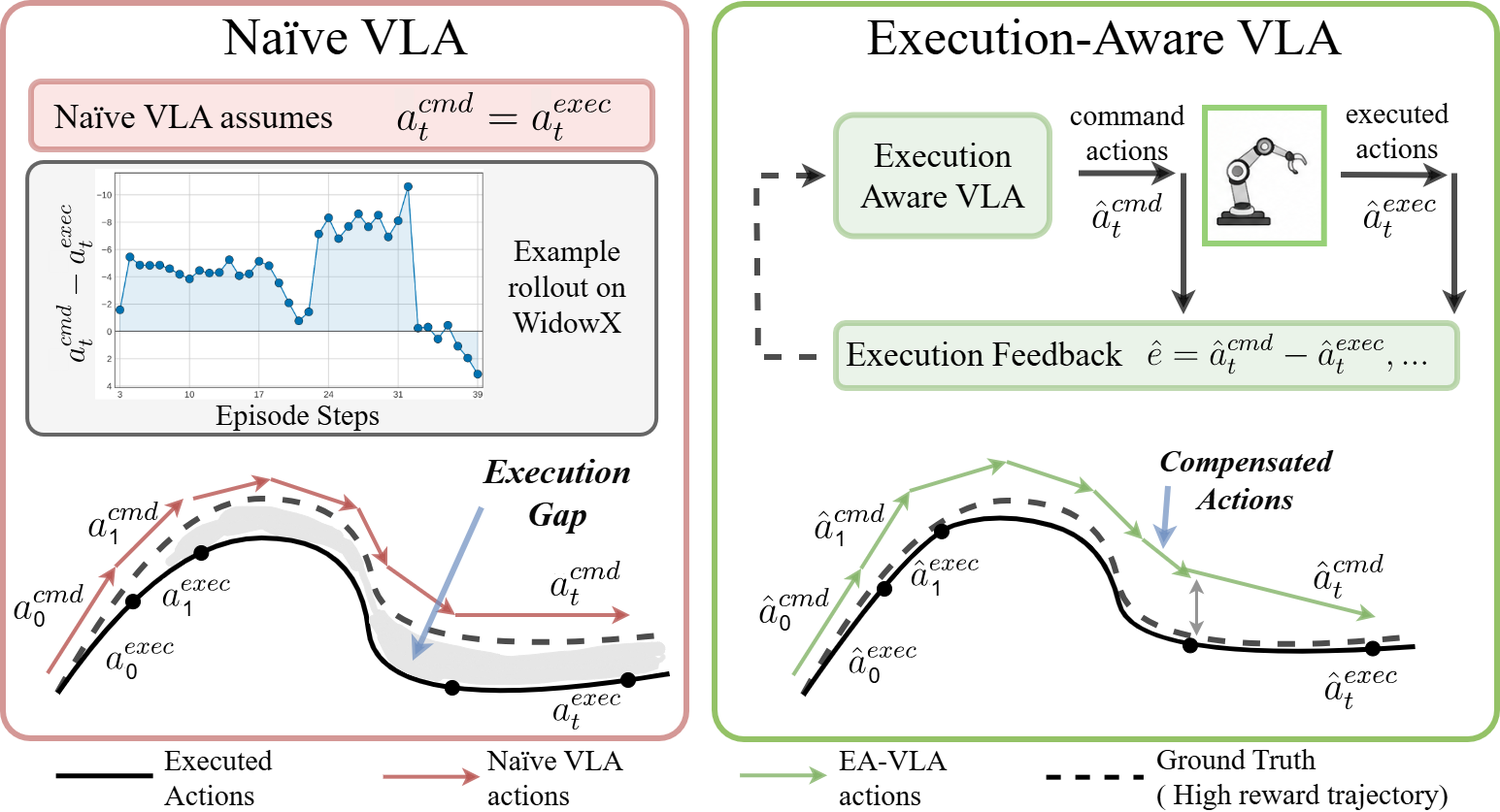
The execution gap. A naïve VLA assumes its commanded action âẓ = âẽ is tracked exactly. In practice, tracking error, latency and actuator effects make executed motion diverge. EA-VLA conditions on execution feedback ê = âẓ − âẽ and produces compensated actions.

TL;DR

Actions predicted ≠ actions executed

Most VLAs treat the low-level execution interface as fixed and reliable. Real robots don't: tracking error, latency, actuator saturation and calibration drift open an execution gap that quietly breaks contact-rich tasks. EA-VLA augments policy inference with execution-state feedback and adapts pretrained VLAs through RL over randomized controller dynamics in simulation — learning to compensate for that gap.

80.1%
success under drift (σ=0.001)
vs. 51.1% for RL baseline
baseline success at the
training threshold (σ=0.01)
+11%
real-world success rate
on the WidowX robot

Method

Execution-aware RL fine-tuning

EA-VLA architecture

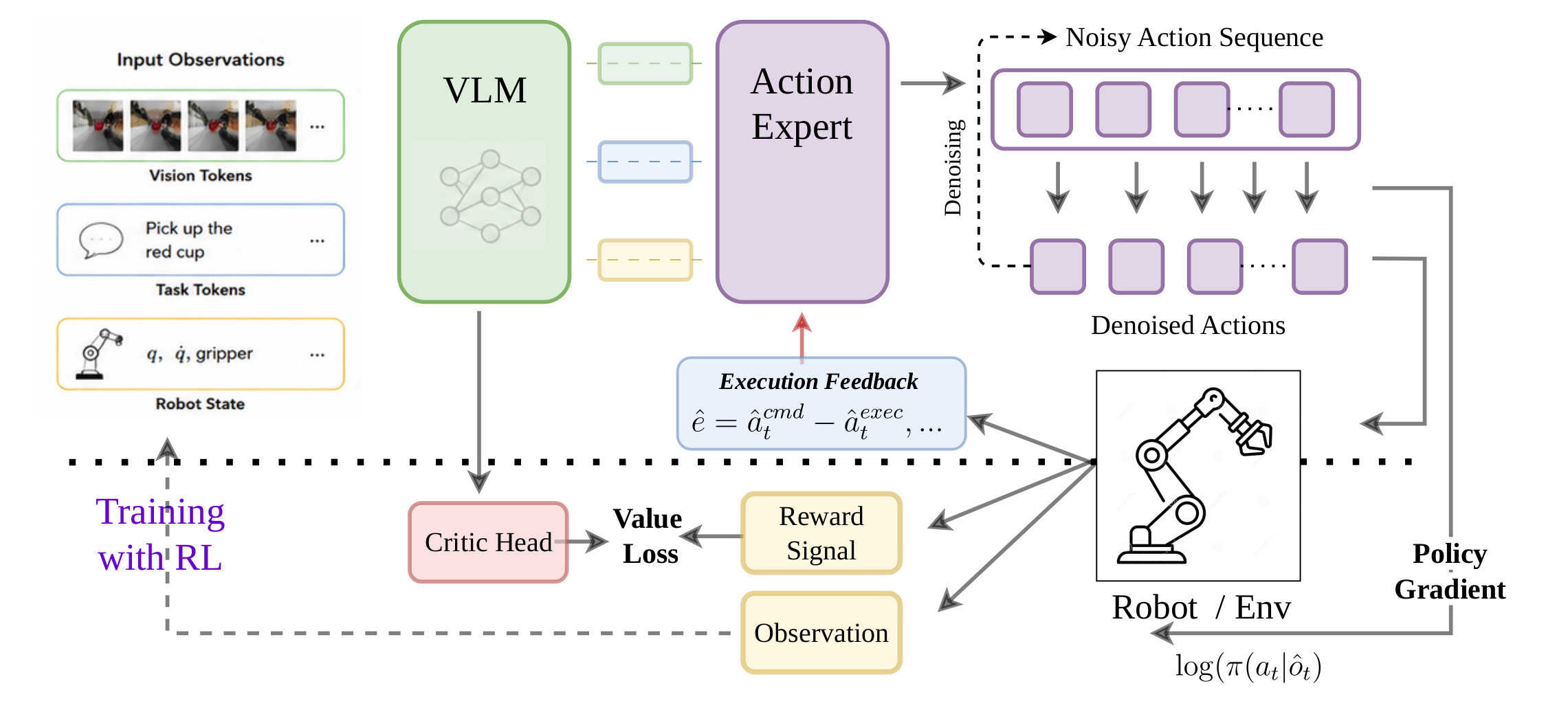
A pretrained VLM + action expert is conditioned on robot state and execution feedback ê = âẓ − âẽ, then fine-tuned with RL in ManiSkill under domain-randomized controller dynamics — exposing the policy to a broad range of execution gaps without real-robot data.

Results

Robust across the execution gap

Success rate vs randomization ratio

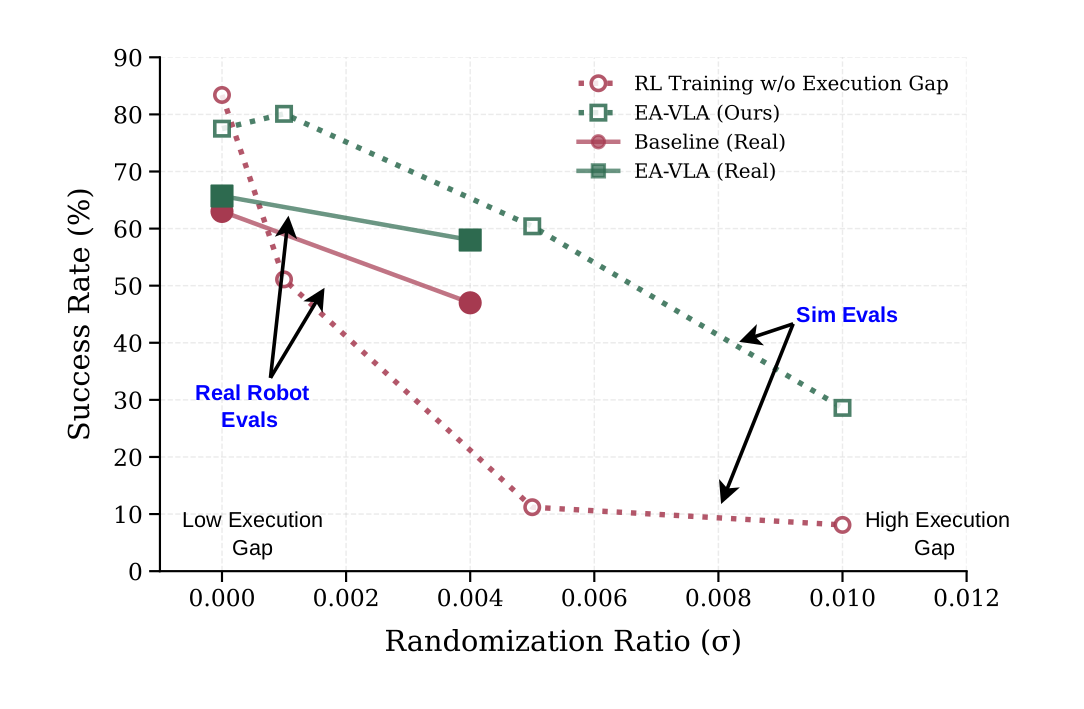
Success rate vs. execution-gap magnitude (randomization ratio σ). EA-VLA (green) degrades gracefully where the baseline collapses — in both simulation (dotted) and on the real robot (solid).

ManiSkill simulation — success rate across randomization ratio σ

Modelσ=0.0σ=0.001σ=0.005σ=0.01σ=0.02σ=0.05
Supervised baseline48.7%49.7%14.2%4.3%2.9%2.5%
RL, no execution gap83.4%51.1%11.2%8.1%4.4%2.2%
EA-VLA (Ours)77.5%80.1%60.4%28.6%6.1%2.6%

Baselines overfit to nominal dynamics and collapse under minor drift; EA-VLA stays robust across two orders of magnitude more perturbation.

Zero-shot sim-to-real (WidowX)

PolicyLow gapHigh gap
Baseline0.630.47
EA-VLA0.660.58

Under true proprioceptive feedback (high gap), the baseline degrades sharply while EA-VLA holds.

Ablation — state-history length H

Hσ=0.0σ=0.001σ=0.005σ=0.01
0 (none)83.4%51.1%11.2%8.1%
170.3%70.5%51.7%22.2%
2 (default)77.5%80.1%60.4%28.6%
476.3%76.3%60.3%26.4%

Execution awareness drives the gains; H=2 balances robustness and cost.